

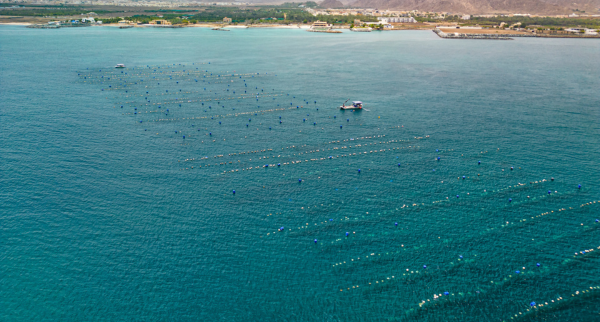
Dibba Bay Oysters farm in the pristine waters of Fujairah, UAE.
In GCC foodservice, a delayed container is no longer just a logistics issue; it can disrupt menus, erode margins, and weaken service levels. The Gulf remains heavily dependent on imported food, with GCC countries importing up to 85% of what they consume. That means sourcing risk is no longer at the edge of operations; it sits at the centre of them. Therefore, proximate sourcing deserves a bigger role now. Not because global trade matters less, but because procurement now has to weigh resilience alongside price and quality.
In a conversation with Nazar Kitabjian, Head of Category at Chef Middle East, he shared insights into how this shift is unfolding and what buyers should be watching more closely.
The strongest argument for resilient sourcing is driven by business need, not ideology. This is not about replacing imports or pretending the GCC can produce every category at scale. It is about reducing overdependence and building smarter supply portfolios.
Kitabjian puts it plainly: “Shorter and more regional supply chains are often easier to map, audit, and defend than opaque multi-tier global chains. That is why local and regional sourcing are no longer just a fallback option. They are part of margin protection.”
Today, they are a practical commercial advantage when used where it delivers the most value. Source locally where freshness and speed matter. Source regionally where shorter transit reduces uncertainty. Source globally where the region still cannot compete on agricultural base, scale, or manufacturing concentration. That is not a compromise. That is strategy.
For years, the sourcing model across much of the industry was built around efficiency. Long-haul routes were assumed to be stable. Chokepoints were assumed to stay open. Unit price was treated as the clearest measure of value. That model now looks incomplete. UNCTAD said ship capacity crossing the Gulf of Aden fell 76% by mid-2024, while Suez Canal tonnage dropped 70%. The FAO said the 2024 global food import bill was expected to exceed USD 2 trillion. This shows that efficiency on paper can unravel quickly when global routes come under pressure. Hence, sourcing decisions need to account for how well they can hold up when volatility becomes a constant in the market.
When shipping capacity tightens and routes come under pressure, the impact does not stop at freight. It affects delivery timelines, cold-chain reliability, insurance, safety stock, working capital, and response speed. It also drives up expediting costs and makes logistics and supply chain management harder.
Kitabjian said, “The economics shifted from lowest unit price to best total risk-adjusted cost”, noting that customers are increasingly judging value through availability, lead time, and consistency, not just invoice price. “That is a significant change in buyer logic. It suggests that procurement teams are no longer asking only what a product costs to buy. They are asking what it costs to keep the business stable.”
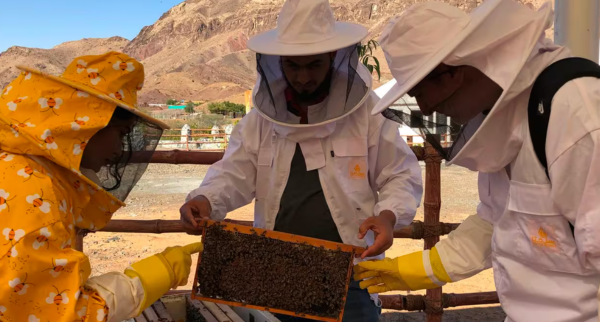
Honey harvesting at Hatta Honey in the UAE mountains.
The constructive part of this story is that the region is not starting from zero. In January 2026, the UAE’s Ministry of Climate Change and Environment launched an initiative to increase local sourcing in the restaurant and hotel sector to 25%. It focuses on boosting the use of locally sourced agricultural and animal products. The ministry also said the UAE has 38,000 farms, an annual vegetable production of around 156,000 tonnes, and domestic output that already covers more than 20% of vegetable demand. Local brands such as New Leaf, Dibba Bay, and Hatta Honey are already driving stronger commercial relevance for closer-to-market supply.
This shifts the focus from production in isolation to stronger integration with hospitality and foodservice demand. Across the wider Gulf, this can strengthen regional coordination and improve sourcing flexibility. It also gives buyers more ways to diversify within the region through markets such as Oman and Qatar.
Supplier diversification works best when each market is used for the resilience it can add. Kitabjian made the regional picture clearer: “The UAE is strongest as a hub for distribution, processing, and re-export, while Oman adds value through port diversification, more resilient inbound routing, and bulk logistics support. Qatar stands out for strategic local supply, reserve-backed stability, and secure coverage of domestic demand.”
This conversation only becomes credible when it stays disciplined. Some lines are already well-positioned for stronger regional depth. Fresh dairy, poultry, eggs, and controlled-environment vegetables are well suited to local or regional sourcing. Shorter turnaround can improve service, reduce waste, and lower the need for excess stock.
Kitabjian stated, “Beef and other red meat lines, coffee, cocoa, and many tropical ingredients will remain globally sourced for structural reasons. The same is broadly true for rice, pulses, spices, nuts, many edible oils, and a wide range of specialised ingredients such as flavours, specialty starches, enzymes, cultures, cocoa derivatives, and some nutritional premixes. In those categories, the agricultural base, climate conditions, manufacturing concentration, and scale economics still sit largely outside the GCC. That distinction keeps procurement grounded in market reality.”
However, nearby sourcing only matters if they improve business operations. Kitabjian added, “For GCC F&B buyers, the biggest advantages of regional alternatives over long-haul imports are speed, shelf life, and control rather than purchase price alone.” He also pointed to shorter lead times, better shelf life, lower safety stock, and faster response, all of which affect availability, waste, and working capital.
Procurement is no longer just buying products. It is buying continuity. In many categories, that now justifies a premium even when it is not the cheapest option.
If the industry wants better outcomes, it needs a better procurement process. Elaborating on the biggest barriers to scaling closer-to-market supply, Kitabjian articulated, “Water and climate constraints remain real. Many upstream inputs are still imported. Cold-chain gaps, uneven supplier scale, weak traceability integration, and financing constraints continue to limit how far local and regional sourcing can expand, how quickly it can mature, and how reliably it can perform at scale.” He further stated, “What needs to improve is resource-efficient production, stronger cold-chain infrastructure, supplier maturity, GCC-wide standards and data interoperability, and sustainable procurement models that reward operational performance rather than headline cost alone.”
That means buyers need to ask tougher questions now. Can a supplier offer alternative origins when a corridor tightens? Can they protect temperature integrity across rerouted flows? Can they adjust pack formats, timing, or specifications when demand changes? Can they share visibility early enough for planning instead of apology?

Soil-grown microgreens and flowers from New Leaf Vertical Farm
In GCC foodservice, the real edge comes from robust supply portfolios, not lower prices. The way forward is not complicated, but it does require conviction. Buyers need category-level sourcing strategies, not broad sourcing slogans. Operators need to stop treating disruption as bad luck and start treating it as a planning input. Suppliers need to be assessed on adaptability, visibility, and execution, not just cost and fill rate. The region needs procurement models that recognise reliable performance as a commercial outcome.
Global sourcing will remain essential. But overconcentration can no longer be justified as the best practice. The industry has enough evidence. What it needs now is action.
Chef Middle East is here to help you build sourcing strategies that are closer, faster, and more controllable.
Discover our Local Seafood products.
For sourcing strategy support, contact your Chef Middle East account manager or visit chefmiddleeast.com
Sign up here: Sign Up | Chef Middle East